
Stress, Trauma and Patrolling
Carol Starkey | August 5th 2025 | News
Title: Stress, Trauma and Patrolling
Patroller health and wellbeing was another focus of the FIPS 2024 Medical Special Interest Group. Per-Olof Michael, Professor of Psychiatry at Uppsala University, Sweden, gave a presentation on Psychotraumatology which was aimed specifically at patrollers. After presenting us with a definition of stress, he looked at some of the effects of stress on body and mind before finally looking at stress mitigation techniques and the principles of stress first aid. This article aims to recap Per-Olof’s presentation before considering the support mechanisms already in place in other FIPS member countries.
Introduction:
Most patrollers patrol because we enjoy skiing or snowboarding, enjoy being in the outdoors with like-minded people and enjoy helping people. Patrollers come from a range of backgrounds, some are medical professionals, others will have first aid experience and all will have extra patrol related training. All try their very best to assist skiers and snowboarders who need help but occasionally this can take its toll on patroller mental health and well-being.
What is stress?
Per-Olof ventured that the essence of stress is uncertainty. The gap between expected and actual outcomes leads to uncertainty which causes stress as the brain tries to resolve this conflict and predict what will happen next. Uncertainty is perceived by the brain as a threat and it prepares the body to react to this potentially dangerous situation by activating the ‘fight or flight’ response, releasing adrenaline into the body, a stimulant which causes heightened awareness of surroundings and increases breathing rate and heart rate. In other words, you’re psychologically and physically good to fight the threat or run away from it!
Is stress always a bad thing? Not necessarily: the right amount of stress can motivate, give focus, provide satisfying results and feel good. Conversely, not enough stress can be de-motivating and too much stress (short or long term) can be toxic and have negative physical and mental effects. Short- or long-term stress can occur because of a number of factors: inner conflict can result in ethical stress (sometimes known as moral injury) caused by witnessing or taking part in behaviours which violate moral values; a perceived threat to life where an experience provokes terror, helplessness or horror can result in traumatic stress; grief, through the loss of cherished people, things or parts of oneself is another cause of stress and chronic stress (wear and tear) can result in fatigue or burn out when stressors from all areas accumulate over time without sufficient rest and recovery.
What are the consequences of too much stress? Each person will have a different tolerance to stress and will have different levels of resilience (the capacity to withstand or to recover quickly from difficulties), based on a variety of factors including past experiences, genetic factors and current environment. However, after an extremely life-threatening or horrific event it is normal to experience after-effects.
Acute Stress reaction (ASR) in the days immediately following the event may include heart palpitations, sweating and shaking, being dazed or slightly disorientated, feeling anxious, sad, angry or despairing and being over-active, under-active or withdrawn. All these symptoms can be attributed to continuing high levels of stress hormones in the body as the brain tries to process the experience and file it away.
These symptoms generally subside over several days and it is important to say that most people will eventually recover well, with no long-term issues. However, a minority of people require additional, professional, support to recover fully and a tiny proportion will continue to feel the effects of the stressful event for a long time, perhaps forever. Acute Stress Disorder (ASD) may develop where symptoms last for longer than 3 days and Post Traumatic Stress Disorder (PTSD) can develop where symptoms are significant and serious, are not resolving after 4 weeks and are adversely affecting quality of life.
Recovery from a stressful event depends on several inter-linked factors including individual risk factors and resilience, the context of the event and the loss of personal resources. Research shows that the availability of short-term support, particularly the support of peers, friends and other social networks adds to resilience and promotes recovery after a stressful incident. The timely identification of issues and the provision or signposting to appropriate mental health support is also crucial.
What to do?
Immediately after a stressful (or potentially stressful) event:
Forced debriefs have been shown to be detrimental, as they force people to relive the stressful emotions and can cause further trauma. An ’After Action Meeting’ is an alternative to a debrief after an emergency response and should include either the full team or the individuals involved in the response. This should be a semi-formal meeting following this format.
|
Introduction |
Detail the purpose of the meeting and provide updated information about the incident. |
|
The Event |
Allow participants to talk about the event if they wish (not necessarily their emotional reaction to it), establishing what happened, determining what went well and identifying what could be done better if the same incident should re-occur. This section is important as it develops learning / abilities, communication and improves team cohesion, all of which increase self-efficacy, social support and reduces the stress impact of the event. |
|
Psycho-education |
Provide education on what to expect in this phase of a stress reaction, reassure that theses reactions are normal and to encourage individual stress management and coping strategies. |
|
Support and follow up |
Can be provided by peer support and utilising tools such as the stress continuum. Consider professional support. |
The stress continuum may be a useful tool; adapted from the military this is now a widely used tool in emergency services and other organisations to assist buddy and self-management.
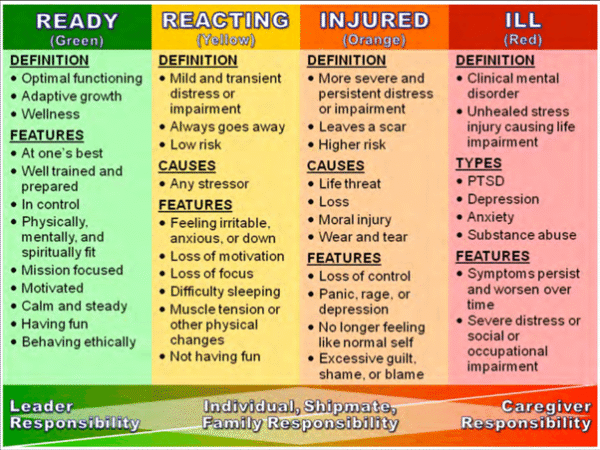
Stress First Aid aims to reduce the effects of stress on responders and includes the 7 C’s of Stress First Aid. This is a taught course, not yet available in the UK, however, the principles of it are worth considering.
- Check on the people involved: Assess, observe and listen.
- Coordinate: Get help / refer as needed to specialist services
These 2 points should always be done.
- Cover: Get to physical / psychological safety.
- Calm: relax, calm down and refocus. Be physically present and listen with compassion.
- Connect: get support from others, encourage cohesion in the work unit and private network.
- Competence: restore effectiveness
- Confidence: restore self-esteem and hope.
These last 5 can be done as necessary.

What do other patrols / patrol organisations do?
In an open discussion with FIPS members it was identified that although many countries have no formal stress management programme several do.
Canada has a national co-ordinator for critical incident stress with national training for groups or individuals. Modules on stress awareness are included in the Patrol training programme and awareness posters and wallet cards are given out. Peer support is available and the programme is expanding across Canada.
NSP (USA) is working on increasing awareness of the potential for stress injury. It is implementing awareness campaign in patrols. Thought to be successful, it is hoped that this will improve patroller resilience.
Sweden: due to small ski patrols, the focus is on peer support. Patrollers are trained in assessment of colleagues and self-assessment.
Australia: Mental Health first aid training is available. Peer and professional support is available at the resorts. They also have an awareness campaign.
What does BASP do?
BASP do not currently have a formal support structure or awareness campaign. Question for the membership: Would further training in stress first aid or similar be beneficial? This may be something to consider and perhaps come back to at the 2025 AGM. It would also be useful to know what plans individual patrols have in place for the benefit of patroller health and well-being after a potentially stressful incident in individual patrols.
Further resources:
www.resus.org.uk Responder Wellbeing (directly related to post cardiac arrest attendance).
https://youtu.be/qoTrLKn0yNw?si=YUIVayyIonDbY2di Youtube video on the stress continuum and stress awareness in an American Ski Patrol.
Christine Gillespie (Chairperson)